Horizontal Asymptote: Rules, Graphs & Limits at Infinity
Both the numerator and denominator grow without bound, but their ratio does not. Move x farther right and watch the quotient settle toward 3 while the graph hugs the horizontal line y=3.
Move the idea
Try it: move x farther to the right
Change one parameter and watch what changes with it.
At infinity, the lower-order pieces fade compared with x. The ratio is controlled by the leading terms: 3x/x → 3, so y=3 becomes the graph’s long-run destination.
Both parts grow
The numerator 3x+1 and denominator x+1 both become large. That alone does not determine the limit; what matters is their relative growth.
Leading terms take over
Divide numerator and denominator by x. The ratio becomes (3+1/x)/(1+1/x). As x grows, both 1/x terms fade toward zero, leaving 3/1.
The asymptote is a destination
The dashed line y=3 records the long-run output. The graph does not need to land on that line; its vertical gap can become as small as we want.
Make the idea reusable.
Positive and negative infinity can differ
A horizontal asymptote can describe x→+∞, x→−∞, or both. For many rational functions the two ends agree, but other functions can approach different horizontal lines on the left and right.
Can a graph cross a horizontal asymptote?
Yes. A horizontal asymptote describes end behavior, not a forbidden boundary. A graph may cross the line at finite x-values and still approach it as |x| becomes large.
Horizontal is not vertical
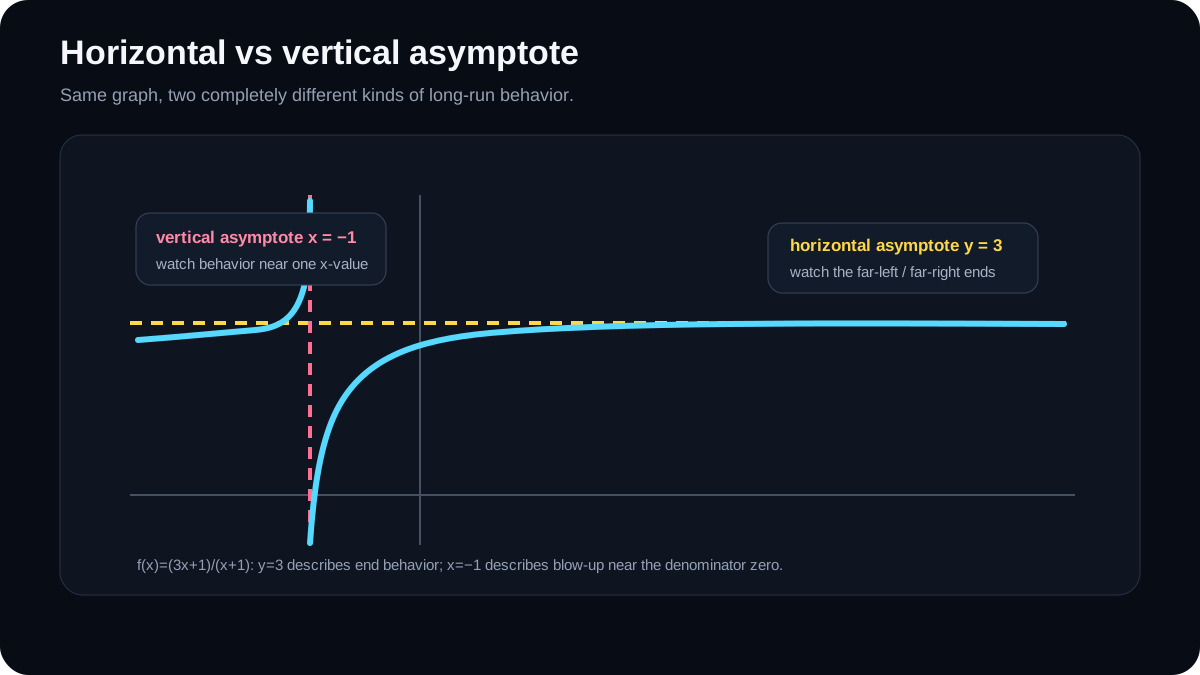
Horizontal asymptotes come from end behavior as |x| grows. Vertical asymptotes come from behavior near a finite x-value where the function grows without bound. They answer different questions.
What is a horizontal asymptote?
A horizontal asymptote is a horizontal line y=L that a function approaches as x goes to positive infinity or negative infinity. In limit notation, y=L is a horizontal asymptote when lim x→∞ f(x)=L, lim x→−∞ f(x)=L, or both. The graph does not have to stay on one side of the line, and it may cross the line at finite x-values.
Horizontal asymptote rules for rational functions
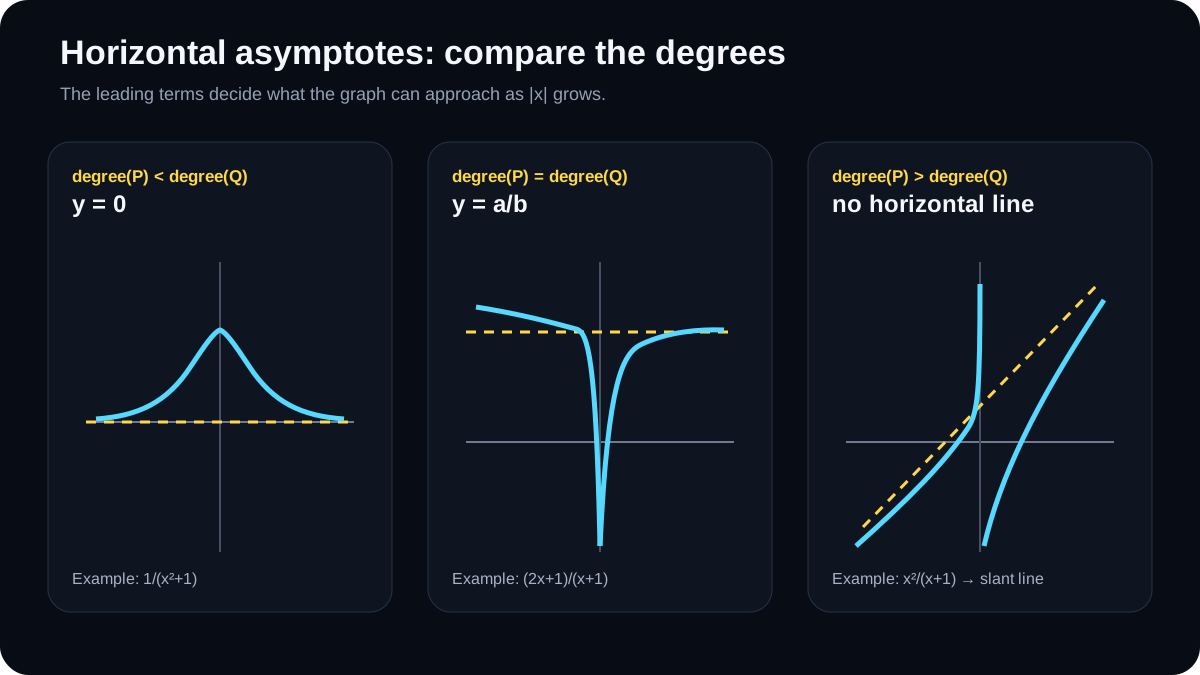
For f(x)=P(x)/Q(x), compare the degree of the numerator P with the degree of the denominator Q. The leading terms determine the long-run ratio.
| Degree comparison | Horizontal asymptote | Why |
|---|---|---|
| degree(P) < degree(Q) | y = 0 | The denominator grows faster, so the ratio approaches 0. |
| degree(P) = degree(Q) | y = leading coefficient of P / leading coefficient of Q | The matching powers of x cancel in the long-run ratio. |
| degree(P) > degree(Q) | No horizontal asymptote | The numerator grows faster. If its degree is exactly one larger, look for a slant asymptote instead. |
See the three degree cases before memorizing them
How to find a horizontal asymptote
- 01Identify the function type
If the function is rational, write it as P(x)/Q(x) and note the degree and leading coefficient of each polynomial.
- 02Compare the degrees
Smaller numerator degree gives y=0; equal degrees give the ratio of leading coefficients; larger numerator degree means there is no horizontal asymptote.
- 03Verify with a limit
When needed, divide by the highest relevant power of x or evaluate the limits as x→∞ and x→−∞. This also catches cases where the two ends behave differently.
- 04Read the graph as end behavior
Treat the asymptote as a long-run destination, not as a wall. Check whether the graph approaches the line from above, below, or crosses it first.
Worked examples for all three rational-function cases
Denominator wins
Horizontal asymptote: y=0. The denominator has degree 2 while the numerator has degree 1, so the denominator grows faster.
Leading coefficients decide
Horizontal asymptote: y=2. Both polynomials have degree 2, so use the ratio of leading coefficients 6/3=2.
No horizontal line
No horizontal asymptote. The numerator degree is one larger than the denominator degree, so polynomial division reveals a slant asymptote instead.
Horizontal vs vertical vs slant asymptotes
| Type | What it describes | Typical example |
|---|---|---|
| Horizontal | End behavior as x→±∞; the output approaches a finite number L. | y=3 for (3x+1)/(x+1) |
| Vertical | Behavior near a finite x=a where |f(x)| grows without bound. | x=−1 for (3x+1)/(x+1) |
| Slant | End behavior approaches a non-horizontal line, usually when the numerator degree is exactly one larger. | y=x+2 for a suitable rational function after division |
Horizontal asymptote FAQ
Can a function cross a horizontal asymptote?
Yes. A horizontal asymptote only describes what happens as x becomes very large in magnitude. Crossing it at a finite x-value does not invalidate the asymptote.
Can a function have two horizontal asymptotes?
Yes. A function can approach one finite value as x→∞ and a different finite value as x→−∞, giving different right-end and left-end horizontal asymptotes.
Does every rational function have a horizontal asymptote?
No. If the numerator degree is greater than the denominator degree, the rational function has no horizontal asymptote. It may have a slant or higher-degree polynomial asymptote instead.
What is the difference between a horizontal asymptote and a limit at infinity?
The limit statement describes the numerical end behavior. When that limit is a finite number L, the line y=L is the corresponding horizontal asymptote.