Δx = (b−a)/n
Split the interval [a,b] into n equal subintervals. Increasing n makes each rectangle narrower.
Approximate the signed area under a curve with left, midpoint or right rectangles. Increase n and watch the rectangles refine while the numerical error updates.
A Riemann sum approximates a definite integral by adding rectangle-like contributions. The general form is Σ f(xᵢ*)Δx, where each subinterval has width Δx=(b−a)/n and xᵢ* is the sample point used to choose that rectangle’s height.
Split the interval [a,b] into n equal subintervals. Increasing n makes each rectangle narrower.
The sample point xᵢ* can be the left endpoint, midpoint, right endpoint, or another point inside the subinterval.
Each term is signed height times width. Adding the terms gives the Riemann-sum approximation.
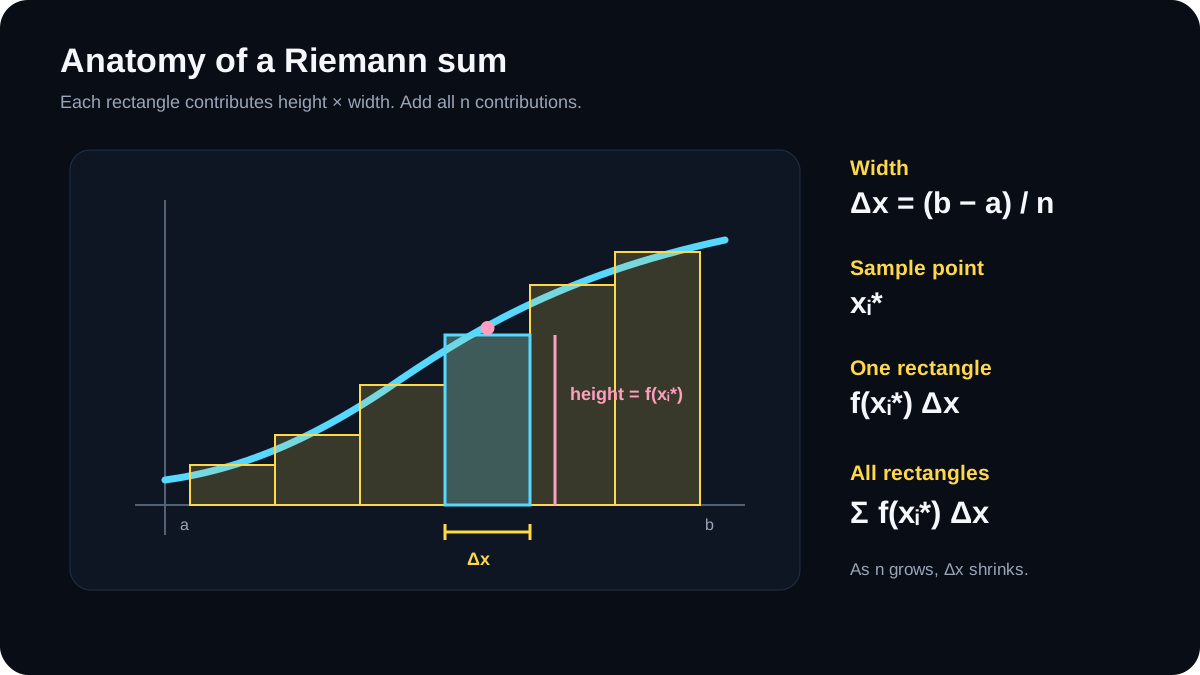
For an increasing positive function, left sums often sit below the true area and right sums often sit above it. Midpoint sampling frequently reduces the error, but the direction of the error depends on the function’s shape.
Use the left endpoint of each subinterval. For f(x)=x² on [0,2], n=4 gives 0.5(0²+0.5²+1²+1.5²)=1.75.
Use each subinterval midpoint. For the same example, n=4 gives 0.5(0.25²+0.75²+1.25²+1.75²)=2.625.
Use the right endpoint. For the same example, n=4 gives 0.5(0.5²+1²+1.5²+2²)=3.75.
With only four rectangles, the midpoint estimate 2.625 is already close. Raise n in the calculator and watch all three methods converge toward the definite integral.
As n increases, Δx shrinks. When f is integrable, the Riemann sums approach one limiting value: the definite integral. The rectangles are a finite approximation; the integral is the limiting accumulated quantity.
Rectangles above the x-axis contribute positively and rectangles below it contribute negatively. A definite integral is net signed accumulation, not always geometric area.
For a well-behaved integrable function, left, midpoint and right sums can start at different values but converge to the same definite integral as the partition gets finer.
Riemann sums define the integral through accumulation. The Fundamental Theorem then connects that integral to antiderivatives, giving an exact evaluation method when an antiderivative is available.
Move an endpoint and watch area become a changing function.
See why accumulated area, derivatives and antiderivatives are two sides of one theorem.
It is the sample point chosen inside the i-th subinterval. Its function value f(xᵢ*) sets the rectangle height.
No. A finite Riemann sum is generally an approximation. Under the usual integrability conditions, the sums approach the definite integral as the partition becomes arbitrarily fine.
The sum uses signed function values. Contributions below the x-axis are negative, so the result represents net signed accumulation unless you explicitly integrate absolute value for total geometric area.